
Contents
- 1 Video Editor Salary in India 2026: An Incredible Opportunity
- 2 Why video editor salary in India varies so much
- 3 What makes a video editor in Chennai different from other cities
- 4 The belief I’ve actually changed on
- 5 Freelance vs. full-time isn’t really a pay question
- 6 So what does video editor salary in India actually look like?
- 7 Frequently Asked Questions
Video Editor Salary in India 2026: An Incredible Opportunity
If you’re searching for a video editor in Chennai, or you’re a video editor in Chennai trying to figure out what you should actually be earning, you’ve probably run into the same problem I have: every salary guide online gives you a different number, and none of them agree with each other. One site says the average is ₹18,000 a month. Another says it’s ₹14 lakhs a year. A third splits the difference and says ₹25,000 to ₹80,000 monthly, depending on “experience and skill level,” which is the kind of sentence that tells you nothing.
I used to think this confusion was just bad journalism — lazy blogs copying numbers from each other without checking anything. Now I think it’s something more honest than that: there isn’t one answer, because “video editor” isn’t one job, and a video editor in Chennai is answering to a completely different market than a video editor in Mumbai or Bangalore.
Why video editor salary in India varies so much
A video editor cutting reels for a D2C brand’s social team, a video editor working post-production for an OTT show, and a video editor doing corporate training videos for an IT company are all technically the same job title. Their day-to-day looks nothing alike, and neither does their pay — which is exactly why video editor salary in India can’t be reduced to one number, and why searching for a video editor in Chennai versus a video editor in a metro like Mumbai will surface wildly different expectations.
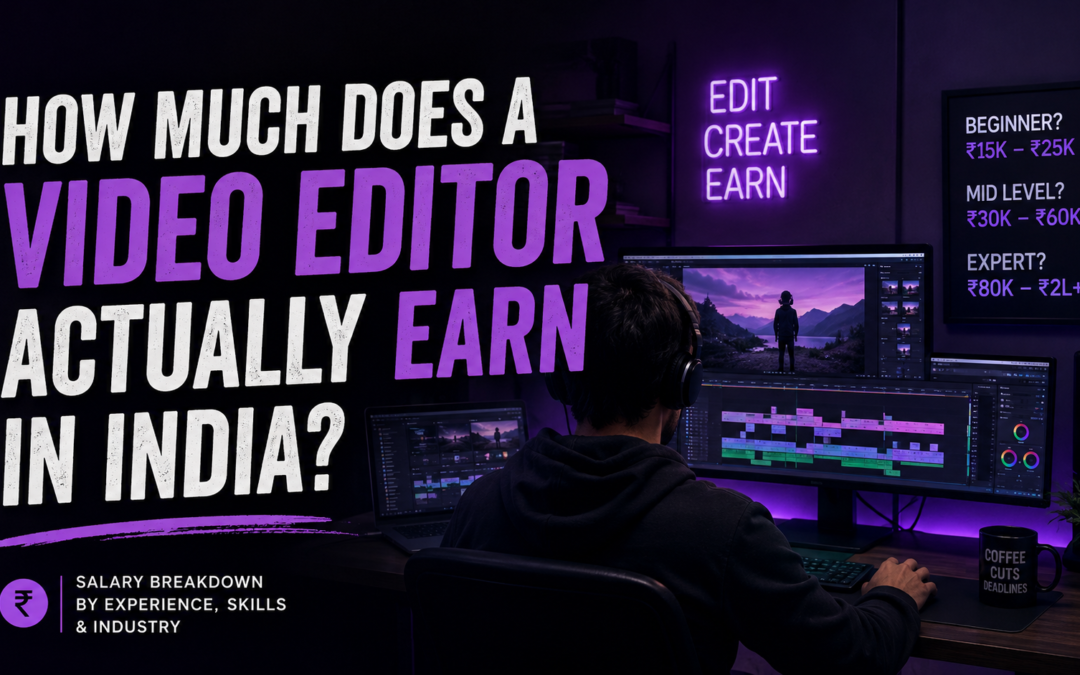
This is the part most salary articles skip. They’ll tell you freshers earn somewhere between ₹15,000 and ₹30,000 a month, and experienced editors can cross ₹10-25 lakhs a year with the right skills. Both of those numbers are true. They’re just describing completely different career paths, not two points on the same line.
What actually moves the number isn’t years of experience on paper. It’s:
- What you’re editing. Entertainment and advertising pay more than corporate content, almost every time, because the margin for creative risk is higher and clients pay for that risk.
- Whether you specialize. Editors who only cut are competing with a much bigger pool than editors who can also do motion graphics, color grading, or sound design. The moment you’re the person who can finish a video end-to-end, not just trim it, you stop being interchangeable.
- City. Mumbai and Bangalore consistently pay more than the national average, partly because that’s where the production budgets are. A video editor in Chennai is often working with a different scale of client — regional brands, growing D2C companies, local production houses — which shifts both the pay ceiling and the kind of work available.
- Software fluency, and I mean real fluency. Not “I’ve opened After Effects.” Knowing which tool actually fits the job, and why, is the difference between someone who follows tutorials and someone clients trust with ambiguity.
What makes a video editor in Chennai different from other cities
Chennai doesn’t get talked about in these salary guides nearly as much as Mumbai or Bangalore, and I think that’s a mistake, because the city’s content ecosystem has changed a lot in the last few years. There’s a real, growing demand for a video editor in Chennai who understands short-form and Reels-style content specifically — not just traditional broadcast or film editing, which is what a lot of the city’s legacy production houses were built around.
What I’ve noticed is that a video editor in Chennai who can move fluidly between long-form and short-form work, and who understands regional content and language nuance, has an advantage that a generic national freelancer often doesn’t. That’s not a small thing. Regional fluency — knowing pacing conventions, cultural references, and what actually lands with a Tamil-speaking or bilingual audience — is a skill that doesn’t show up on a resume, but it shows up immediately in the final cut.
This also means the salary conversation for a video editor in Chennai isn’t purely about matching Mumbai numbers. It’s about whether the local market recognizes and pays for that specialization yet, and increasingly, it does.
The belief I’ve actually changed on
For a long time, I thought editing speed was the skill that got you paid more. Cut faster, take on more projects, earn more. It’s a reasonable thing to believe, because it’s true up to a point.
What I’ve come to think instead is that speed caps out fast, and taste doesn’t. Anyone can learn to cut quickly within a year or two. Very few people develop an actual eye for pacing, for when a cut should breathe and when it shouldn’t, for what makes a video feel finished instead of just technically complete. That’s the skill that doesn’t have a ceiling, and it’s the one none of these salary breakdowns know how to measure, so they just leave it out.
I think this matters even more for a video editor in Chennai specifically, because the city’s market is still maturing. The editors who’ll benefit most from that growth aren’t the fastest ones. They’re the ones building a genuine point of view.
Freelance vs. full-time isn’t really a pay question
Most of the guides bring up freelancing as the “earn more” option, and it’s not wrong. Editors working with international clients or multiple retainers genuinely can out-earn a full-time salary. But that comparison always gets framed as if it’s purely financial, and I don’t think that’s the real trade-off.
Full-time work gives you consistency and, if you’re lucky, a team that pushes your craft. Freelancing gives you range, upside, and the discomfort of income that isn’t guaranteed month to month. Neither one is the “smarter” choice. They’re just different bets on what kind of stability you’re willing to trade for what kind of growth.
For a video editor in Chennai weighing this decision, the calculation includes one more variable: whether the local client base is developed enough yet to support a full freelance career, or whether a full-time role gives better access to the kind of high-production-value work that builds a stronger reel over time.
So what does video editor salary in India actually look like?
If you want a number instead of a range: as a fresher, expect somewhere in the ₹2.5–4 lakh annual bracket depending on the industry you land in. By the time you have a few years in and a specialization — motion graphics, color, sound — ₹8-15 lakhs isn’t unusual in the right city and industry.
For a video editor in Chennai specifically, the range tends to sit slightly below Mumbai and Bangalore at the senior end, but the gap is closing fast as more national and international brands look outside the usual metro hubs for editing talent. Remote work has helped here too — a video editor in Chennai working with clients elsewhere in India or abroad isn’t capped by what the local market alone pays.
Past a certain point, the ceiling has much less to do with experience and much more to do with whether you’ve become the kind of editor a client asks for by name instead of by job title. (For a broader data pull across cities and experience bands, Glassdoor’s video editor salary data is a decent cross-check.)
That last part is the one thing every salary chart in the world will always fail to capture. Numbers can tell you what the market pays for a title. They can’t tell you what it pays for someone it trusts.
Frequently Asked Questions
What is the average video editor salary in India? It depends heavily on experience and industry, but most sources place the overall range somewhere between ₹2.5 lakhs a year for freshers and ₹15+ lakhs a year for experienced, specialized editors. Anyone giving you a single number without asking what you edit and where is guessing.
Does a video editor in Chennai earn less than one in Mumbai or Bangalore? Often, yes, at the higher end of the range — but the gap is narrowing as more remote and national work reaches editors based in Chennai, and as the city’s own content ecosystem grows around short-form and regional work.
What skills increase a video editor’s pay the most? Specialization does more than raw experience. Motion graphics, color grading, and sound design all push an editor out of the “generic cutter” pool and into a much smaller, better-paid category.
Is video editing a good career for someone in Chennai right now? The demand for a video editor in Chennai has grown significantly with the rise of short-form content and regional brand marketing. It’s a genuinely good time to be building this specific skill set in this specific city.
Do freelance video editors earn more than full-time employees? They can, especially with international or multiple-client work, but it’s not a guaranteed upgrade. It’s a different risk profile — more income potential, less predictability — not simply a better-paying version of the same job.
Want to understand the actual difference between roles before you chase a number? Read Video Editor vs Motion Graphic Designer next.