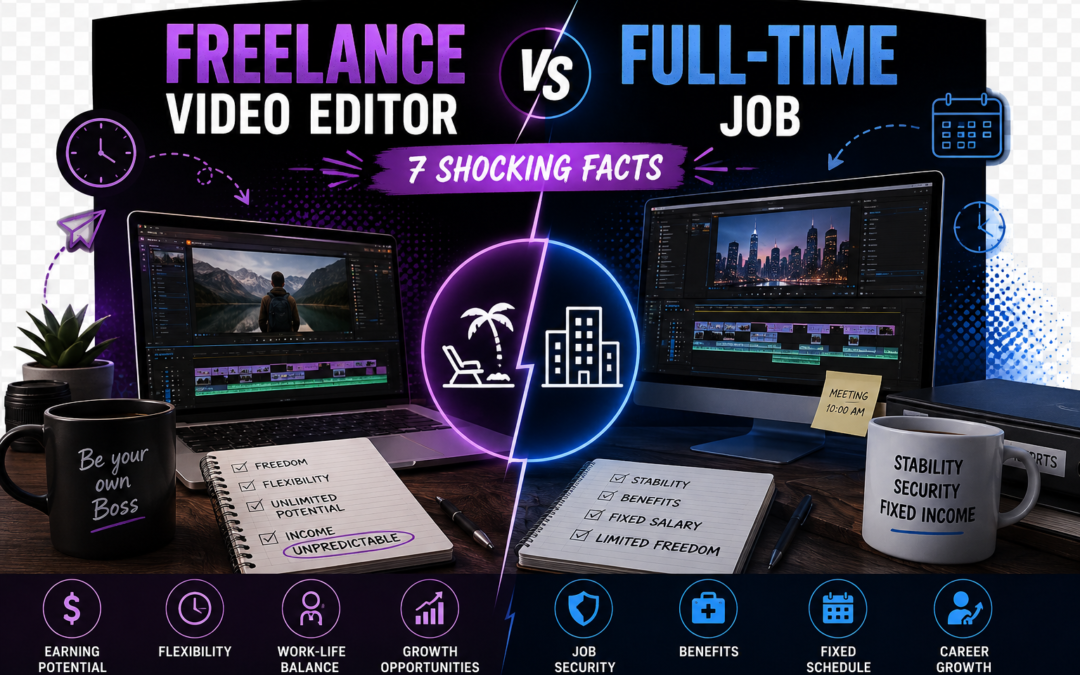
Quick answer: A freelance video editor vs full-time job comparison usually comes down to this: freelancers earn more per project but face less stability, while full-time editors get a steady paycheck, teamwork, and faster skill growth early on. The right choice depends on your skill level and how you learn best, not which path sounds more impressive.
Choosing between freelance work and a full-time job is one of the biggest decisions a video editor makes. It shapes your income, your schedule, and how fast you grow creatively. Here’s a clear, honest breakdown of both paths.
Contents
- 1 What Does a Freelance Video Editor Do?
- 2 What Does a Full-Time Video Editor Do?
- 3 Freelance Video Editor vs Full-Time Job: The Real Differences
- 4 Pros and Cons of Freelance Video Editing
- 5 Pros and Cons of Full-Time Video Editing Jobs
- 6 Which Path Grows Your Skills Faster?
- 7 How to Decide Which Path Is Right for You
- 8 Which Personality Fits Which Path?
- 9 What Clients and Employers Actually Look For
- 10 Making the Transition
- 11 Can You Do Both?
- 12 Common Myths About Freelance vs Full-Time Editing
- 13 Final Thoughts
- 14 Frequently Asked Questions
What Does a Freelance Video Editor Do?
A freelance video editor works for themselves, taking projects from different clients instead of one employer. They find their own clients, set their own rates, choose which projects to accept, and manage their own taxes and invoices. Freelancing gives control over schedule and project variety, but none of it is guaranteed. Anyone comparing freelance video editor vs full-time job options should understand this trade-off first, since it shapes almost every other difference between the two paths.
What Does a Full-Time Video Editor Do?
A full-time video editor works for one company, usually reporting to a creative director or producer. They work fixed hours, edit for one brand or agency, and receive a steady monthly salary regardless of workload. Full-time roles offer consistency and built-in feedback from a team, which is often the biggest reason editors choose this path early in their career.
Freelance Video Editor vs Full-Time Job: The Real Differences
Income and Pay
Freelance income can be higher, but it’s inconsistent. A skilled freelance editor working with international clients can out-earn a full-time salary in a good month. For a broader look at how editor pay compares across experience levels, Payscale’s salary data is a useful cross-check. Full-time pay is lower per hour on average, but predictable.
Job Security
Full-time jobs come with more built-in security through contracts and benefits. Freelancing has no guaranteed income. If a client disappears, that income disappears with them.
Creative Freedom
Freelancers usually choose which projects to take and can specialize in a specific style or industry. Full-time editors work within a company’s existing brand guidelines, with less freedom over project choice but less pressure to find work.
Skill Growth
This is the most overlooked difference in any freelance video editor vs full-time job comparison. Full-time roles come with built-in feedback from senior editors, which speeds up skill development early in a career. Freelancers often work alone, so growth depends heavily on self-awareness.
Pros and Cons of Freelance Video Editing
Pros: higher earning potential, freedom to choose clients, flexible schedule and location, exposure to varied industries and styles, no single employer controlling your career path.
Cons: unpredictable income, no built-in feedback or mentorship, full responsibility for finding clients, no paid leave or health benefits, isolation without a team to collaborate with daily.
Pros and Cons of Full-Time Video Editing Jobs
Pros: predictable income, built-in mentorship and faster early growth, team collaboration, benefits and clearer boundaries, access to bigger-budget projects a solo freelancer might not land alone.
Cons: lower earning ceiling compared to top freelancers, less control over which projects you work on, slower path to creative independence, career growth tied to one company’s decisions, less flexibility in hours and location.
Which Path Grows Your Skills Faster?
Early on, structure speeds up learning. It’s easier to build real editing instincts when someone experienced is regularly giving feedback. A full-time role often builds foundational skills faster than freelancing, simply because feedback is built into the job.
Later, once those instincts are developed, the equation flips. Freelancing then rewards editors who already know what they’re doing, since there’s no one double-checking the work before a client sees it. This is why the answer to freelance video editor vs full-time job questions often changes as skill level changes.
How to Decide Which Path Is Right for You
Ask yourself these questions honestly. (For more on how skill level changes this calculation, see The Belief I’ve Actually Changed On from our earlier piece on this topic.)
- Do you learn faster from feedback, or from being fully responsible for a result on your own?
- Can you handle inconsistent income right now?
- Do you want variety, or do you want depth?
- Are you self-motivated without external deadlines pushing you?
Which Personality Fits Which Path?
Editors who feel energized by variety, switching between different clients and industries, often find freelancing genuinely enjoyable. Editors who feel most productive with a predictable routine often find full-time work far less stressful. Self-discipline matters more on the freelance side, since there’s no manager checking in if a deadline starts slipping.
Neither trait is fixed. Many editors develop stronger self-discipline over time, which is part of why the answer to freelance video editor vs full-time job questions can change as a person changes.
What Clients and Employers Actually Look For
Clients hiring a freelancer are usually solving a short-term problem: they need a specific skill they don’t have in-house, or extra capacity without committing to a long-term hire. They value speed, clear communication, and reliability above all else.
Companies hiring full-time are thinking longer term. They want someone who grows with the brand and becomes a dependable part of the team, so they’re often willing to invest in training and mentorship because they expect the relationship to last months or years.
Making the Transition
Moving from full-time to freelance means suddenly handling tasks that used to happen invisibly in the background, software licenses, invoicing, and client outreach all become your own responsibility. Many editors underestimate how much time this takes until they’re doing it for the first time.
Moving from freelance to full-time means adjusting to structure that used to be self-directed. Fixed hours and working within someone else’s creative guidelines can feel restrictive at first, though this adjustment usually eases within a few months.
Can You Do Both?
Yes. Many editors move between freelance and full-time work more than once over a career. A common pattern is starting full-time to build skills, then transitioning to freelancing once confident. Others do the reverse. There’s no rule that says you have to pick one path forever.
Common Myths About Freelance vs Full-Time Editing
Myth: Freelancing always pays more. Not always. Income varies month to month, and many freelancers earn less overall than a stable salary once slow months are averaged in.
Myth: Full-time jobs limit creativity. Not necessarily. Many editors do their most ambitious work inside a full-time role, since a steady pipeline of real projects gives room to take creative risks.
Myth: You have to pick one path for life. False. Editors switch between freelance and full-time work multiple times as their needs change.
Myth: A full-time job is always the safer choice. Not always. Full-time roles can end through layoffs just as freelance work can dry up. Neither side of the freelance video editor vs full-time job decision offers guaranteed permanent security.
Final Thoughts
There’s no universally “better” choice in the freelance video editor vs full-time job decision. Both paths can lead to a successful career. What matters is matching the path to your current skill level, finances, and how you learn best, and revisiting that choice every year or two rather than treating it as permanent.
Frequently Asked Questions
Is it better to be a freelance video editor or work full-time? Neither is universally better. Full-time roles help early-career editors grow faster through built-in feedback. Freelancing rewards editors who already have strong skills and want more control over income and projects.
Do freelance video editors make more money than full-time editors? They can, especially with international clients, but income is inconsistent. Full-time editors earn less per hour on average but receive a steady paycheck every month.
Can a video editor switch from freelance to full-time later? Yes. Many editors move between both paths multiple times. It’s common to start full-time to build skills, then transition to freelancing once confident, or the other way around.
What skills do freelance video editors need that full-time editors don’t? Freelancers need strong client communication, self-editing discipline, invoicing skills, and the ability to judge their own work without daily feedback from a team.
Is freelance video editing a stable career? It can be, but it requires building a reliable client base over time. Income is less predictable than a full-time salary, especially in the first year or two.
How do I know if I should stay full-time or start freelancing? Ask whether you currently grow faster with feedback from others or with full responsibility on your own, and whether your finances can handle inconsistent income right now.
Is one option in the freelance video editor vs full-time job debate more respected in the industry? No. Both paths are common and equally respected among professional editors. What matters more to clients and employers is the quality of the work and how reliably an editor delivers it, not which employment structure they chose.